CONTEMPORARY GLOBAL FICTION by Sushmindar Jeet Kaur
₹750.00
25 in stock
Publisher : PENPRINTS; First Edition (25 October 2024)
Language : English, English
Hardcover : 377 pages
ISBN-10 : 8196793278
ISBN-13 : 978-8196793272
| Weight | 450 g |
|---|
Related products
-
Add to cartThe Dark Republic by Sunil Sharma is a gripping, genre-bending political thriller that journeys into the heart of a shadowy world where democracy mutates into tyranny and truth becomes the first casualty. Told through the eyes of Marco Columbus—an intrepid war correspondent who stumbles upon a secretive, technologically advanced kingdom hidden deep within the Central American wilderness—the novel unravels a chilling narrative of power, surveillance, manipulation, and the terrifying allure of authoritarian rule. As Marco is drawn into the labyrinth of the “Dark Republic,” he uncovers diaries, testimonies, and histories that reveal how utopias collapse into dystopias, how ordinary citizens become subjects, and how strongmen rise through fear, mythmaking, and the machinery of the modern state. Expansive in vision and relentless in pace, The Dark Republic blends political drama, speculative fiction, reportage, mythology, and philosophical inquiry into a sweeping saga that mirrors the anxieties of the contemporary world. From street protests in Hong Kong and rebel lands in the Middle East to the hidden citadels of an underground empire, Sunil Sharma crafts a haunting cautionary tale about democracy’s fragility and the global drift toward authoritarianism. Bold, provocative, and disturbingly relevant, this novel invites readers to confront the forces shaping our world—and warns of the republics we may unknowingly be building.
-
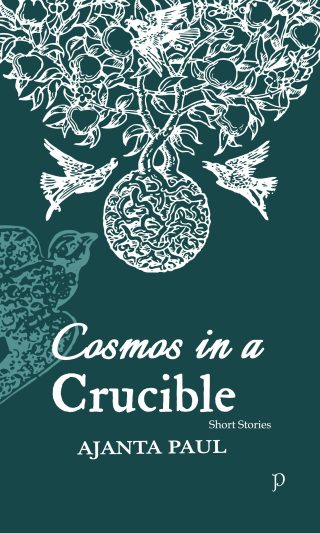
Add to cartIn Cosmos in a Crucible, Ajanta Paul presents a luminous collection of sixteen short stories that transform the mundane rituals of urban Indian life—from the search for a new apartment to the sensory memories of a family recipe book—into profound meditations on the human condition. With the precision of a poet and the keen eye of a sociologist, Paul explores the “microphysics of power” within domestic and social spheres, capturing characters as they navigate the delicate intersections of tradition, displacement, and ethical choice. Whether depicting the spectral lingering of grief in “Flat-Hunting” or the visceral terror of communal history in “The Blue Kameez,” these stories move with a quiet narrative economy that culminates in startling “epistemic jolts,” forcing readers to re-evaluate the boundaries between the ordinary and the extraordinary. This debut collection is an essential read for those seeking literary fiction that blends intellectual rigor with deep emotional resonance, marking the arrival of a sophisticated voice in contemporary Indian literature.
-
Add to cartThe voice in this volume of poetry is that of the poet Sushmindar Jeet Kaur as a seeker, constantly in search of light. Each poem, suffused in the humility of a wayfarer, moves bit by bit to get closer to the unknowable. The “unfathomable” gets to be more intriguing and complex as the journey progresses. As one goes along with the movement of the poems, the “silhouettes of meaning” become visible, and each “silence speaks of a deeper calling”; there emerges a note of assurance for the reader who is the co-traveller with the poet. Eventually, as the poet puts it eloquently, the “wayfarer becomes the path”. Mysteries of life begin to surface more and more, and gradually an inward reality begins to surface. The remarkable confession -so to speak- of the poet comes as a gentle shock when she declares that she is not a good woman! In choosing the path of her own journey, she is no longer a conformist. She is, in the eyes of the world, a rebel. The matter-of-fact tone of the declaration is actually the voice of conviction.While reading these poems, the intensely felt reality appears to acquire a surreal aura. Several lines in the poems get charged with an energy that beckons “not an end but a return”. What keeps the attention of the reader engaged in these poems is also the dynamic of Time as a continuum. Added to the experience is the unmissable spiritual dimension of the poems, offering moments of intersection of the past and future. This is when the poet’s poignant reflection that “Forgetting is a betrayal” comes into play. Whether it is the “whispering of the winds” or the “language of the earth”, she is receptive and demonstrates a keen understanding of those voices.Clearly, Sushmindar Jeet Kaur is someone who has chosen the path of meditating through poetry. This is also the path of love that abandons boundaries of all kinds, even those perceived between life and death. It is crucial to note here that this is not poetry of self-indulgence but that of theStrength of hunger-Of craving, of deprivation,of appetite, of famishment-Of nights spent counting starsSince the coins were too few to buy sleep.And the poet recognises how people who are deprived have so much to give:Yet the affection they give with hands that have nothingnothing but the strength to hold on, to endureand to teach the rest of uswhat it means to be alive.For this poet, soulful connections, even though with “the ache of solitude”, can lead one to experience a fulfilling homecoming in the flow of time. The poems call for the awakening of an inner light…Sukrita Paul KumarIndian Poet, Critic & Academic
-
Add to cart
Ketaki Datta is an Associate Professor of English with W.B.E.S. She is a novelist, short story writer, poet, translator, editor and reviewer. She has two novels to her credit, “A Bird Alone” [2008] and “One Year for Mourning” [2014]. She has translated three novels, “Shesh Namaskar: The Last Salute” [Sahitya Akademi, 2013], “Jarasandha’s Paadi: The Voyage” [Booksway, 2009], “Dhruvaputra” by Amar Mitra (in press), Selected Short Stories of Rabindranath Tagore in Translation” [Avenel, 2015]. Some of her notable translations are “Kumarsambhab and Sakuntala” in “Pracin Sahitya” [Visva Bharati and CENTIL, J.U.,2017], “Nineteenth Century Women’s Writing and Writing for Women in Translation” [Bhawanipur Education Society College and CENTIL, J.U.,2015], “Pratibha India”, anthologies like “Three Stories” by Tapan Bandyopadhyay [2012] etc. Datta’s umpteen translated stories were published in “Indian Literature” [Sahitya Akademi]. Her “Oral Stories of the Totos” has been recently published by Sahitya Akademi [2021]. Her short stories have been published in different anthologies in India and abroad, and also in The Sunday Statesman, Contemporary Vibes etc. “The Music of Eternity” – A Collection of Poems has been published by Penprints in 2023.
-
Add to cart
Walking, Wandering, Wayfaring, a collection of short stories, uses the ‘literature of journey’ genre and its premise of the quest for meaning, both as scaffolding and metaphor, to intertwine travels of the body, mind, and spirit. As these voyages are not separate or linear and written into the emotional core of each narrative, this collection deliberately sets aside the order of the pursuit, bringing forward the ‘way’ as the vibrant space where the seeking happens. The narratives immerse the readers in the physical, nomadic wanderings of both men and women, the latter’s often more anarchist and map-less—on roads, highways, mountains, fields, rivers, ponds, forests, cities, villages, village squares, mofussil towns, and even cremation grounds—each a treacherous terrain where the route is not an inert backdrop but actively influences the traveller and their thoughts.
Even as the wayfaring shakes up the sojourners’ illusory sense of normalcy and routines, and pitches them between despair and hope, and belonging and un-belonging, it ignites within them a life energy, an élan vital, that brings deliverance, as they become the path and exude its spirit of freedom. As people tramp on their journeys, not necessarily by choice but certainly by necessity, the question lingers: did the wanderer find the way, or did the way find the wanderer?
The tales, at the same time, focus on individuals experiencing a ‘rite of passage’, as their minds transition from one way of life and perspective to another. While they reflect on the fragility of the human psyche, they also celebrate growth, transcendence, and healing.The collection also engages in a contrasting journey, an unhurried one, of letting go—releasing the hinges of ‘I’ and ‘mine’—where characters discover that true freedom, the site of all meaning, lies in liberating all transient paths and attachments, and in recognising the God within themselves—to find an enormous, true, permanent, healing and luminous world that reveals the cosmic significance of existence.